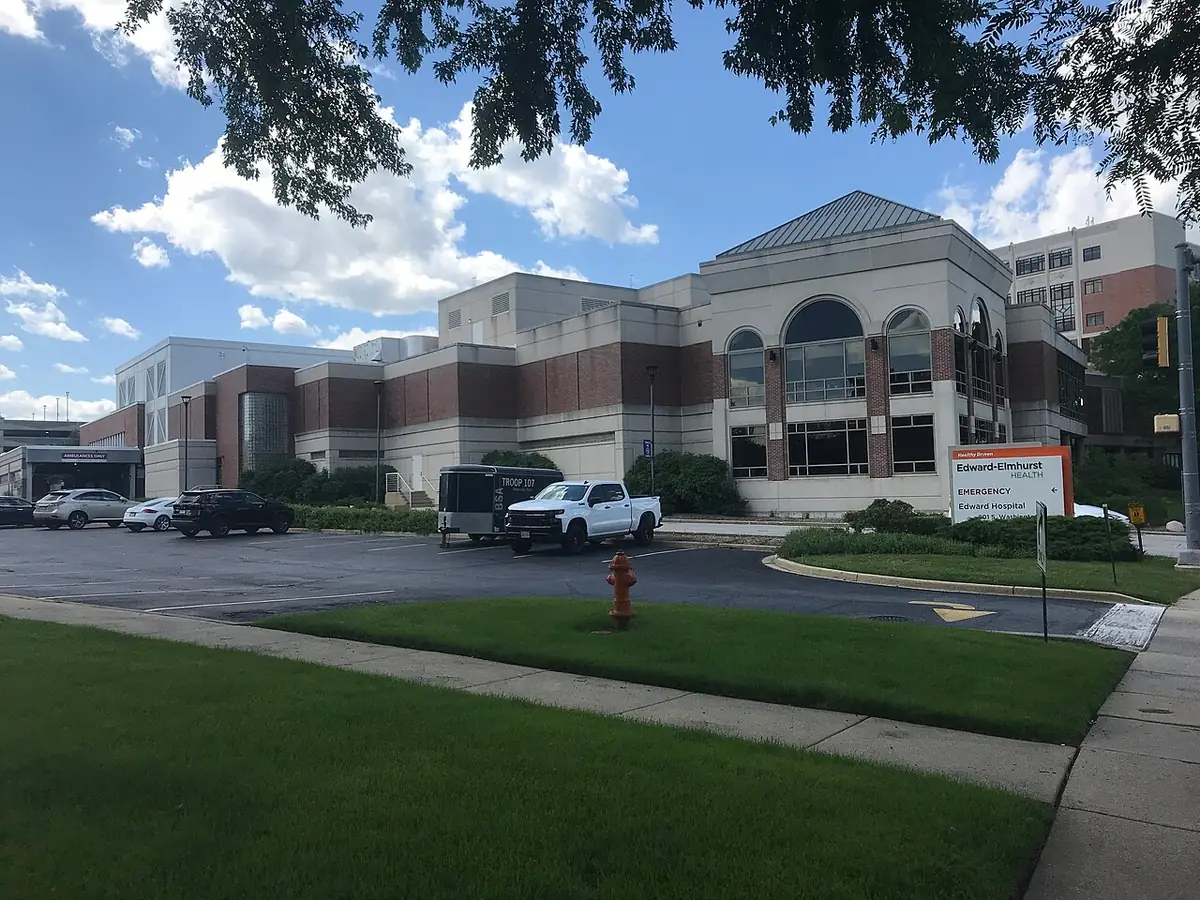

Quick answers
- Does Edward Hospital have an emergency room?
- Yes. Medicare (CMS) data lists emergency services at Edward Hospital. In a medical emergency, call 911.
- Where is Edward Hospital?
- 801 South Washington, Naperville, IL 60540, in Du Page County, Illinois.
- What is the phone number of Edward Hospital?
- (630) 527-3000, as listed by Medicare (CMS).
- What is the Medicare star rating of Edward Hospital?
- 3 out of 5 stars in the CMS overall hospital quality rating (CMS data updated 2026-10-26).
- Does Medicare reduce its payments to Edward Hospital for hospital-acquired conditions?
- No. For fiscal year 2026, CMS lists no Medicare payment reduction for Edward Hospital under the Hospital-Acquired Condition Reduction Program (Total HAC Score: -0.4026; a lower score is better). It is an adjustment to what Medicare pays the hospital, not a charge to patients (CMS data released January 26, 2026).
Specialties and care areas[4][5][6]
- Cardiovascular
- Neurosciences
- Orthopaedics
- Oncology
- Primary care
- Imaging
- Lab
- Pharmacy
- Pediatric emergency care
Programs and centers[4]
- Labor and delivery
- Mother and baby unit
- Neonatal intensive care unit
- Pediatric intensive care unit
Emergency care (hospital website)[4][5][6]
| Emergency room | Yes |
|---|---|
| Trauma designation | Level II |
| Stroke designation | Comprehensive Stroke Center (DNV certification) |
Visiting and practical information
| Visiting | Hours vary by unit, e.g. adult critical care 7 a.m.-9 p.m.; labor and delivery and NICU open 24 hours[4] |
|---|---|
| Parking | Free parking in North and South decks; free weekday valet at ER, North, Cancer Center and MOB entrances[4] |
| Interpreters and languages | Free telephone, video and in-person interpreters for patients and families[4] |
| Patient portal | MyEndeavor |
Recognition[5][6]
- Level II trauma center
- Comprehensive Stroke Center certification (Det Norske Veritas, DNV)
Doctors and clinicians (1,257)
1,257 doctors and other clinicians list Edward Hospital as a hospital where they work, in Medicare's official clinician data (updated 2026-10-02). It is not a complete staff list.
Main specialties
- Nurse Practitioner182
- Family Practice129
- Internal Medicine127
- Physician Assistant116
- Anesthesiology60
- Orthopedic Surgery46
- Hospitalist41
- Obstetrics/Gynecology41
- Diagnostic Radiology38
- Emergency Medicine35
- Gastroenterology32
- Cardiovascular Disease (Cardiology)31
Doctors with a page on this site (1,257)
- Aarti Manchanda, MDEndocrinology
- Abby A. Sikorcin, PAPhysician Assistant
- Abdullah Quddus, MDInterventional Cardiology
- Abhishek Bhandari, MDGastroenterology
- Abigail BergerPhysician Assistant
- Abigail C. LernerNurse Practitioner
- Adam D. Klugman, MDGastroenterology
- Adam D. Stein, MDEndocrinology
- Adam Spurlock, NPNurse Practitioner
- Adam T. Schriedel, MDInternal Medicine
- Aditya A. Dholakia, DOGastroenterology
- Adnan W. Ali, MDDiagnostic Radiology
- Adriana S. Tanner, MDNeurology
- Afroz A. Hai, MDCardiac Electrophysiology
- Agim Jusufi, MDInternal Medicine
- Agnieszka Nowak, MDEmergency Medicine
- Agron B. Elezi, MDInternal Medicine
- Ahmad El Kouzi, MDNeurology
- Ahmad Nourallah, MDGeneral Surgery
- Ahmad O. Raslan, MDPulmonary Disease
- Ahmed A. Cheema, MDNeurosurgery
- Ahmed N. Hassan, MDCritical Care (Intensivists)
- Aiman Ghufran, MDGastroenterology
- Aisha S. Bhatti, MDAnesthesiology
And 1,233 more: the button below opens the full list.
Names link to the doctor’s page on this site when there is one, otherwise to the official NPI Registry record (U.S. Department of Health and Human Services). Find a doctor · Source: CMS Facility Affiliation Data
Other emergency rooms nearby
Hospitals that list emergency services, by straight-line distance (not driving distance).
- Copley Memorial Hospital6.6 mi · Aurora, IL · Acute Care Hospital
- UChicago Medicine AdventHealth Bolingbrook6.6 mi · Bolingbrook, IL · Acute Care Hospital
- Northwestern Medicine Central Dupage Hospital7.8 mi · Winfield, IL · Acute Care Hospital
- Advocate Good Samaritan Hospital8.2 mi · Downers Grove, IL · Acute Care Hospital
- Presence Mercy Medical Center9.4 mi · Aurora, IL · Acute Care Hospital
Find the closest emergency room to where you are → · Compare ER wait times
Other hospitals near Naperville
- Linden Oaks at Edward0.4 mi · Naperville, IL · Psychiatric Hospital
- Marianjoy Rehabilitation Center7.1 mi · Wheaton, IL · Inpatient Rehabilitation Hospital
All hospitals in Naperville · Hospitals in Du Page County · Hospitals near me
Nursing homes, hospice, home health and dialysis nearby
Medicare-certified providers within 25 miles, by straight-line distance. Hospice and home health care is given at home: their address is the office.
Nursing homes
- The Pearl of Naperville0.2 mi · Naperville, IL · 3 of 5 stars
- Alden Estates of Naperville1.8 mi · Naperville, IL · 3 of 5 stars
- Arista Healthcare1.9 mi · Naperville, IL · 5 of 5 stars
All nursing homes in the state →
Hospice providers
- Family Paramount Hospice LLC3.5 mi · Naperville, IL
- Lighthouse Hospice Care LLC3.5 mi · Naperville, IL · 3 of 5 stars
- Three Oaks Hospice3.5 mi · Naperville, IL · 3 of 5 stars
All hospice providers in the state →
Home health agencies
- Elite Care at Home, Inc0.3 mi · Naperville, IL
- Greatland Home Health Services, Inc0.3 mi · Naperville, IL · 5 of 5 stars
- Inswan Home Health Agency, Ltd2.6 mi · Naperville, IL · 1.5 of 5 stars
All home health agencies in the state →
Dialysis facilities
- FMC - Naperbrook2.6 mi · Naperville, IL · 3 of 5 stars
- FMC - Naperville North Dialysis Center3.5 mi · Naperville, IL · 3 of 5 stars
- Fox Valley Dialysis Ltd4.9 mi · Aurora, IL · 3 of 5 stars
Outpatient surgery centers nearby
Medicare-certified ambulatory surgery centers within 25 miles, by straight-line distance.
- Midwest Endoscopy Center, LLC0.3 mi · Naperville, IL
- Naperville Surgical Centre0.3 mi · Naperville, IL
- DMG Pain Management Surgery Center4.5 mi · Naperville, IL
Community care nearby
Health centers, clinics, urgent care and pharmacies closest to this hospital, by straight-line distance, from official HRSA, Medicare and NPI Registry data. In a medical emergency, call 911.
Community health centers
- Will County Community Health Center Brooks Middle School5.4 mi · Bolingbrook, IL · Community health center
- Aunt Martha's Aurora Community Health Center6.2 mi · Aurora, IL · Community health center
- Will County Community Health Center - North6.2 mi · Bolingbrook, IL · Community health center
Clinics and urgent care
- Medexpress Urgent Care Illinois, P.C.0.3 mi · Naperville, IL · Urgent care center
- Pulse Urgent Care PC0.3 mi · Naperville, IL · Urgent care center
- Rylander Medical3.5 mi · Naperville, IL · Urgent care center
Pharmacies
- 1918 Winter Street Operating Co LLC0.3 mi · Naperville, IL · Community/retail pharmacy
- Edward Hospital0.3 mi · Naperville, IL · Community/retail pharmacy
- Healys Edward Campus Pharmacy0.3 mi · Naperville, IL · Community/retail pharmacy
About the Medicare star rating
CMS (the federal Medicare agency) gives many hospitals an overall rating from 1 to 5 stars, based on measures of mortality, safety, readmissions, patient experience and timely care. It is one piece of information: ask your doctor what matters for your care. See the full Medicare profile →
Medicare quality data
What Edward Hospital reported to Medicare (CMS), the federal agency that publishes these results for hospitals nationwide. These are averages for many patients, not a prediction for any one person: ask your doctor what matters for your care. In a medical emergency, call 911.
What patients said (patient survey)
What this means: Patients who stayed overnight answered a national survey (HCAHPS) about their stay. More stars mean patients reported a better experience than at other hospitals. The percentages show how often patients gave the best answer, next to the national average.
| Summary star rating (all survey topics) | 3 of 5 stars |
|---|---|
| Overall rating of the hospital | 3 of 5 stars |
| Would recommend the hospital | 4 of 5 stars |
| Nurses communicated well | 4 of 5 stars |
| Doctors communicated well | 3 of 5 stars |
| Patients got help quickly from staff | 3 of 5 stars |
| Staff explained medicines | 2 of 5 stars |
| Information about recovery at home | 3 of 5 stars |
| Room and bathroom kept clean | 2 of 5 stars |
| Restfulness of Environment | 3 of 5 stars |
| Care Coordination | 3 of 5 stars |
| Symptoms After Stay | 3 of 5 stars |
| Rated the hospital 9 or 10 out of 10 | 71%National average: 72% |
| Would definitely recommend the hospital | 74%National average: 71% |
| Nurses “always” communicated well | 80%National average: 80% |
| Doctors “always” communicated well | 78%National average: 80% |
| “Always” got help as soon as they wanted | 61%National average: 64% |
| Staff “always” explained medicines before giving them | 58%National average: 62% |
| Were given information about recovery at home | 84%National average: 86% |
| Room and bathroom “always” clean | 58%National average: 73% |
| Completed surveys | 3,013Response rate: 24% |
Source: Patient survey (HCAHPS) - Hospital — CMS, released October 19, 2026; patients discharged January 2025 to December 2025.
Infections caught in the hospital
What this means: CMS compares the number of infections patients caught in this hospital with the number expected for a hospital like it. The number shown is that ratio: below 1 means fewer infections than expected, above 1 means more. “Better” or “worse” is shown only when the difference is clear in the data.
| Central line bloodstream infections (CLABSI) | 0.145Better than the national benchmark |
|---|---|
| Catheter-associated urinary tract infections (CAUTI) | 0.344No different from the national benchmark |
| Surgical site infections after colon surgery | 0.831No different from the national benchmark |
| Surgical site infections after abdominal hysterectomy | 2.318No different from the national benchmark |
| MRSA bloodstream infections | 1.021No different from the national benchmark |
| Clostridioides difficile (C. diff) intestinal infections | 0.501Better than the national benchmark |
Source: Healthcare Associated Infections - Hospital — CMS, released October 19, 2026; data from January 2025 to December 2025.
Complications and deaths
What this means: Death rates are the share of patients who died within 30 days of going into the hospital for that condition, adjusted for how sick they were. PSI-90 combines several serious complications (a lower number is better). “No different from the national rate” is the most common result and means the hospital is in line with hospitals nationwide.
| Deaths within 30 days: heart attack patients | 11.6% |
|---|---|
| Deaths within 30 days: heart failure patients | 10.3% |
| Deaths within 30 days: pneumonia patients | 14% |
| Deaths within 30 days: COPD patients | 6.4% |
| Deaths within 30 days: stroke patients | 13.7% |
| Deaths within 30 days: coronary bypass surgery (CABG) | 2.3% |
| Serious complications (patient safety indicator PSI-90) | 0.74No different from the national rate |
| Complications after hip or knee replacement | 4.1% |
Source: Complications and Deaths - Hospital — CMS, released October 20, 2026; data from July 2022 to June 2025.
Return visits to the hospital (readmissions)
What this means: The share of patients who had to be admitted to a hospital again within 30 days after going home, adjusted for how sick they were. A lower percentage is better.
| Returned to any hospital within 30 days (all patients) | 17.1% |
|---|---|
| Readmitted within 30 days: heart attack | 14.8% |
| Readmitted within 30 days: heart failure | 22.8% |
| Readmitted within 30 days: pneumonia | 19.6% |
| Readmitted within 30 days: COPD | 21.5% |
| Readmitted within 30 days: coronary bypass surgery | 11% |
| Readmitted within 30 days: hip or knee replacement | 5.8% |
Source: Unplanned Hospital Visits - Hospital — CMS, released October 20, 2026; data from July 2024 to June 2025.
Emergency room times and sepsis care
What this means: ER time is the middle (median) time from arriving at the emergency room to leaving it; busier ERs usually have longer times, so the ER volume is shown too. Leaving before being seen: a lower percentage is better. Sepsis is a life-threatening reaction to an infection; a higher percentage means more patients got every recommended early step.
| Emergency room volume (patients per year) | Very high (60,000 or more) |
|---|---|
| Average (median) time patients spent in the emergency room before leaving (OP-18b) | 163 minutesNational average: 162 minutes |
| Patients who left the emergency room before being seen (OP-22) | 2%National average: 2% |
| Sepsis patients who got all the recommended early care (SEP-1) | 65%National average: 66% |
Source: Timely and Effective Care - Hospital — CMS, released October 19, 2026; data from January 2024 to December 2024.
Medicare payment programs
Medicare (CMS) uses these federal programs to adjust what it pays hospitals, based on quality, safety and cost results. This is a payment to the hospital for Medicare patients, not a price you pay, and not a prediction for any one person. Results for Edward Hospital, fiscal year 2026 (October 2025 to September 2026).
Show the Medicare payment program results
Hospital-Acquired Condition Reduction Program
What this means: Medicare gives each hospital a Total HAC Score built from patient-safety complications and from infections caught in the hospital. The quarter of hospitals with the highest (worst) scores gets a reduction in its Medicare payments. A lower score is better.
CMS says: Hospitals with a Total HAC Score above the 75th percentile of the Total HAC Score distribution will be subject to a 1-percent payment reduction.
| Medicare payment reduction, fiscal year 2026 | NoCMS lists no payment reduction for this hospital. |
|---|---|
| Total HAC Score | -0.4026Lower is better. Hospitals above the 75th percentile of all scores get the reduction. |
Source: Hospital-Acquired Condition (HAC) Reduction Program — CMS, released January 26, 2026; patient-safety data from July 2022 to June 2024 and infection data from January 2023 to December 2024.
Hospital Readmissions Reduction Program
What this means: For six conditions, Medicare compares how often this hospital’s patients had to go back into a hospital within 30 days with how often that happens at an average hospital with similar patients. The ratio is that comparison: 1 means as many readmissions as expected, above 1 means more than expected (CMS calls these “excess readmissions”), below 1 means fewer.
CMS says: In October 2012, CMS began reducing Medicare payments for subsection(d) hospitals with excess readmissions under the Hospital Readmissions Reduction Program (HRRP).
| Heart attack | 1.0982More readmissions than expected |
|---|---|
| Heart failure | 1.0381More readmissions than expected |
| Pneumonia | 0.9982Fewer readmissions than expected |
| COPD (chronic lung disease) | 1.0681More readmissions than expected |
| Hip or knee replacement | 1.1499More readmissions than expected |
| Coronary bypass surgery (CABG) | 1.0747More readmissions than expected |
Source: Hospital Readmissions Reduction Program — CMS, released January 26, 2026; patients discharged July 2021 to June 2024.
Hospital Value-Based Purchasing Program
What this means: Medicare scores hospitals in four areas, each from 0 to 100, and combines them into a Total Performance Score from 0 to 100. A higher score means better results on these measures. Medicare uses the score to adjust what it pays the hospital.
CMS says: This program adjusts payments to hospitals under the Inpatient Prospective Payment System (IPPS) based on the quality of care they deliver.
| Total Performance Score | 26.92 out of 100Median of the 2,455 hospitals in the program: 29.50 |
|---|---|
| Clinical outcomes (deaths and complications) | 21.67 out of 100 |
| Person and community engagement (patient survey) | 26.00 out of 100 |
| Safety (infections and sepsis care) | 40.00 out of 100 |
| Efficiency and cost reduction (Medicare spending) | 20.00 out of 100 |
Source: Hospital Value-Based Purchasing (HVBP) - Total Performance Score — CMS, released January 26, 2026, fiscal year 2026. Program description: The Hospital Value-Based Purchasing (VBP) Program — CMS, page last modified September 10, 2024.
Medicare spending per patient (MSPB)
What this means: This compares what Medicare spent on a hospital stay, counting the 3 days before it and the 30 days after, with the national median hospital, after adjusting for the patient’s age and health and for local prices. A ratio of 1.00 is the national median hospital; below 1.00 means Medicare spent less, above 1.00 means more. It measures the cost to Medicare, not the quality of care.
CMS says: The Medicare Spending Per Beneficiary (MSPB) Measure shows whether Medicare spends more, less, or about the same for an episode of care (episode) at a specific hospital compared to all hospitals nationally.
| Medicare spending per patient, ratio | 0.96Below the national median hospital (1.00): Medicare spent less |
|---|
Source: Medicare Spending Per Beneficiary - Hospital — CMS, released October 19, 2026; data from January 2024 to December 2024.
ER wait times and Medicare ratings nearby
How this hospital compares with others in the area, ranked only by official Medicare (CMS) numbers.
Prices
We have not been able to read a price file for Edward Hospital yet. Every US hospital must publish its standard charges online (federal price transparency rule): look for “price transparency” or “standard charges” on the hospital’s website, or call the hospital and ask for an estimate. In a medical emergency, call 911.
Hospital information
| Hospital type | Acute Care Hospital |
|---|---|
| Address | 801 South Washington, Naperville, IL 60540 |
| County | Du Page County |
| State | Illinois |
| Phone | (630) 527‑3000 |
| Emergency services | Yes |
| Ownership | Voluntary non-profit - Private |
| Medicare overall rating | 3 of 5 stars |
| Birthing-friendly designation | Yes (meets CMS criteria) |
| CMS Certification Number | 140231 |
| Name in Medicare records | EDWARD HOSPITAL |
| Profile level | Medicare data + hospital website |
| Official website | endeavorhealth.org |
| Corrections | Report an error or suggest an update → |
Sources
- Hospital General Information — Centers for Medicare & Medicaid Services (CMS), data updated 2026-10-26, retrieved 2026-11-13
- Medicare Care Compare — official Medicare profile of this hospital
- U.S. Census Bureau Geocoder — map position used for distances
From the hospital’s website
Numbers match the citations above. Checked 2026-10-30.
- Edward Hospital | Endeavor Health — endeavorhealth.org
- Emergency care | Endeavor Health — endeavorhealth.org
- Edward Hospital Emergency & Pediatric Emergency Department | Endeavor Health — endeavorhealth.org